

Takeaway: waiting for a 20% deposit often delays homeownership, whereas leveraging government schemes allows entering the Gladstone market with just 5% savings . This strategic approach accelerates the buying timeline significantly by combining automated saving habits with state-specific grants. Utilizing the Home Guarantee Scheme specifically can cut years off the journey compared to traditional saving methods.
Watching property prices rise while your bank balance grows slowly is the single biggest frustration for aspiring homeowners today. This guide reveals the best saving strategies for first home buyers Australia has available to help you build a deposit without sacrificing your lifestyle.
You will discover how to automate your savings, maximize state grants, and use smart financial hacks to enter the property market months ahead of schedule.
- Set the Right Deposit Target: Stop Guessing
- The 30-Day Reset to Accelerate Your Savings
- Government Schemes: Your Shortcut to a Deposit
- Queensland-Specific Grants and Concessions
- The Costs Most Buyers Forget (and How to Plan for Them)
- Practical Accelerators and a Sample Timeline
Set the Right Deposit Target: Stop Guessing
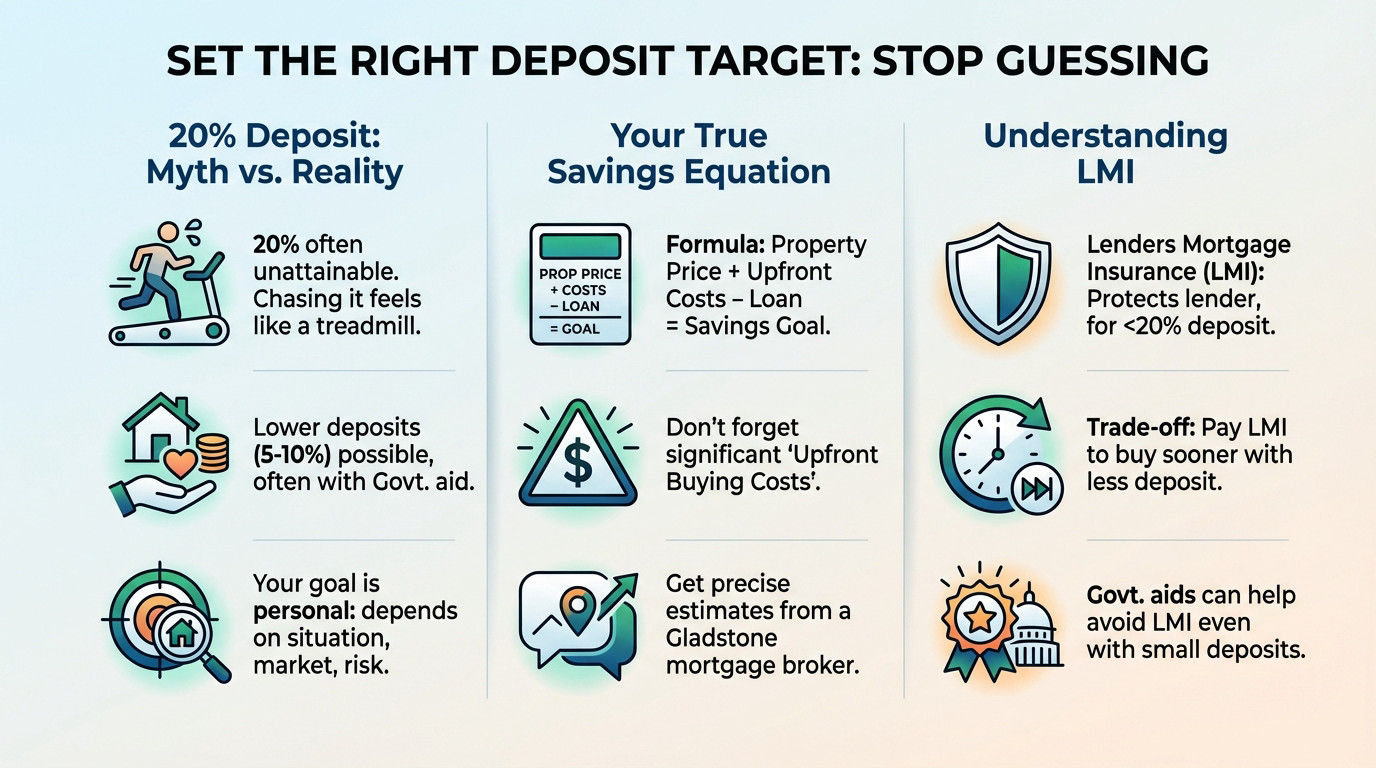
The 20% Deposit Is a Myth for Many
Sticking rigidly to a 20% deposit isn’t always one of the best saving strategies for first home buyers Australia offers today. It often delays your entry while prices rise . You stay stuck renting longer.
Here is the reality: getting in with 5% or 10% is completely viable now . Government schemes can bridge the gap, though they come with specific conditions you need to accept.
Ultimately, the “perfect” number isn’t fixed; it depends entirely on your budget, the Gladstone market, and risk tolerance.
Chasing a 20% deposit while property prices are rising can feel like running on a treadmill. You’re working hard but not actually getting any closer to your goal.
Calculating Your Real Savings Goal
Stop guessing and use this simple formula: Property Price plus Buying Costs, minus your Loan Amount, equals your Savings Goal . It’s basic math, yet most people skip the “buying costs” part until it’s too late.
The deposit is just one slice of the pie; you must account for upfront buying costs. Stamp duty, building inspections, and conveyance fees can easily add thousands to your final bill .
Online calculators give you a ballpark figure, but speaking with a mortgage broker in Gladstone ensures you aren’t blindsided by hidden local fees.
Understanding LMI and the Trade-offs
Lenders Mortgage Insurance (LMI) is often misunderstood as protection for you, but it actually only covers the bank if you default . Lenders generally demand this insurance policy whenever your deposit sits below that 20% threshold.
However, paying LMI might be the price of admission to stop renting years earlier . It’s a calculated trade-off.
That said, specific government guarantees can help eligible buyers skip this cost entirely , even with a small deposit.
The 30-Day Reset to Accelerate Your Savings
Now that you have a clear goal, it is time to build the engine that will get you there. Forget complex budgets; we are going to set up a simple and automated system.
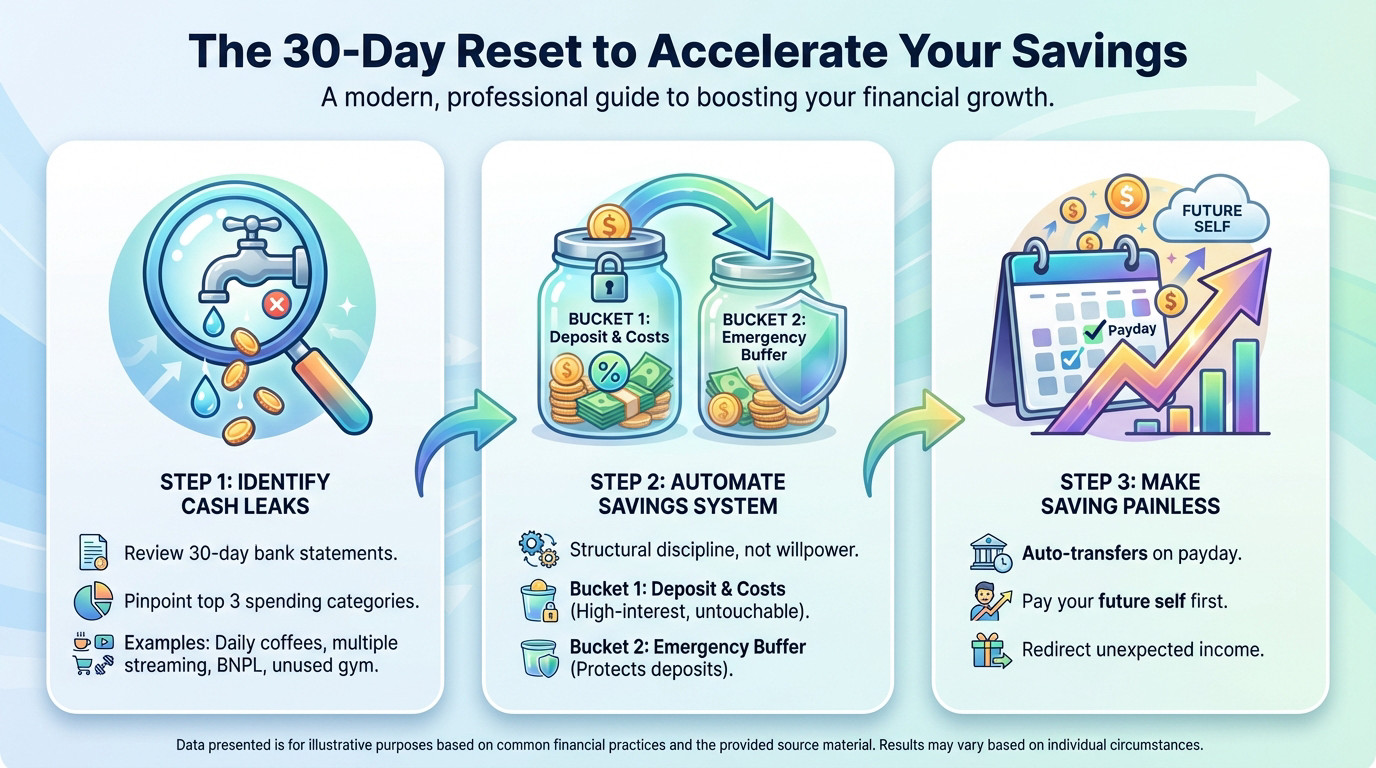
Find Your Cash Leaks: The First 30 Days
Stop guessing where your money goes. This best saving strategies for first home buyers Australia reset isn’t about punishment; it is about spotting the unconscious habits draining your wallet .
Grab your bank statements from the last 30 days right now. Identify the top three categories where cash disappears , because you can’t fix a leak you don’t see.
It isn’t big bills that kill a deposit; it is the silent, daily tap-and-go transactions that ruin your progress. You might be shocked at how the “small” stuff adds up.
- Daily coffees and takeaway lunches .
- Multiple streaming service subscriptions .
- “Buy now, pay later” payments .
- Unused gym memberships .
Automate a ‘Two-Bucket’ Savings System
Willpower eventually runs out. The secret to buying in Gladstone is structural discipline, separating your money so you don’t accidentally spend your deposit at the pub.
Bucket 1 is your deposit and costs account. This money is strictly off-limits and must sit in a high-interest savings account to compound while you sleep.
Bucket 2 is your emergency buffer . This fund protects your hard-earned deposit from life’s nasty surprises, like a blown car tyre or sudden medical bill.
Personalised financial coaching can help you set up this system effectively.
Make Saving Automatic and Painless
The most critical step is setting up automatic transfers on payday. Pay your “future self” first , ensuring the money is gone before you see it.
This removes emotion from the equation completely. If the money isn’t in your transaction account, you can’t spend it on impulse buys .
Whenever you get a tax return or bonus, transfer it to the deposit bucket immediately. Treat these windfalls as accelerators, not free spending money.
Government Schemes: Your Shortcut to a Deposit
A solid savings system is the baseline. But to genuinely accelerate your timeline , you have to use the levers the government puts right in front of you.
The First Home Super Saver Scheme (FHSSS) Explained
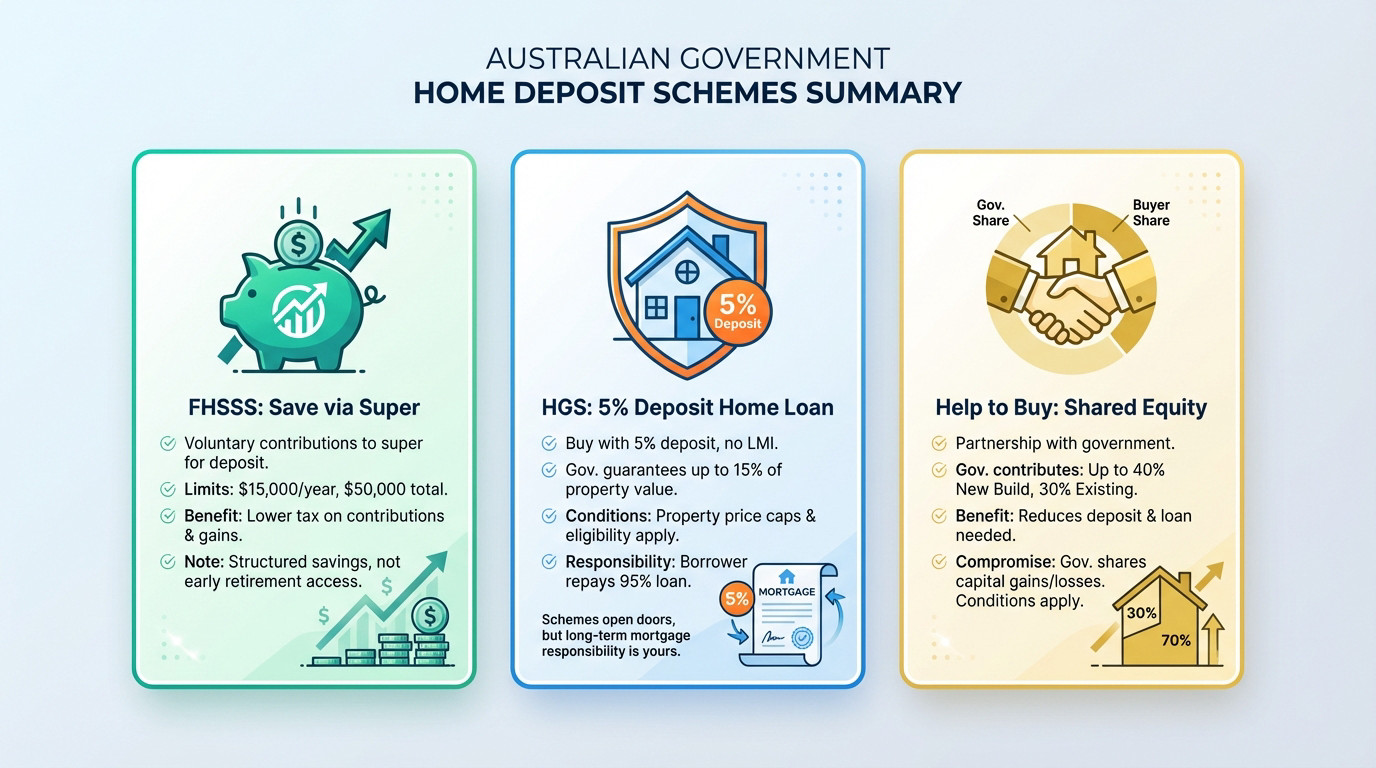
The First Home Super Saver Scheme (FHSSS) allows you to make voluntary contributions to your super fund specifically to save for a deposit. It is a smart way to build wealth faster .
Current limits allow you to contribute up to $15,000 per financial year, capping at $50,000 total across all years. Since these contributions and earnings are taxed at a lower rate, your savings grow much quicker .
Don’t confuse this with “raiding your retirement.” It is a highly structured program with strict release rules , perfect for buyers who aren’t purchasing tomorrow.
Buying with 5% Using the Australian Government 5% Deposit Scheme
Managed by Housing Australia, the Australian Government 5% Deposit Scheme, formerly the Home Guarantee Scheme, allows eligible buyers to purchase a home with a 5% deposit and no LMI. Since 1 October 2025 there are no income caps and no waitlists.
Here is how it works: the government guarantees up to 15% of the property’s value , which satisfies the lender’s risk requirements. Just remember that property price caps and specific eligibility criteria apply to your application.
Even with the guarantee, you must be able to service the full loan . You are still borrowing 95% of the purchase price.
Government schemes can open doors, but they aren’t free money. They reduce the upfront barrier, but the long-term responsibility of the mortgage remains entirely yours.
Understanding Help to Buy (Shared Equity)
The Help to Buy scheme operates differently; think of it as a partnership with the government. It uses a “shared equity” model to lower the hurdle of homeownership.
The government contributes up to 40% for a new build or 30% for an existing home. This massively reduces the deposit you need to save and shrinks your ongoing mortgage repayments .
There is a trade-off . The government shares in the future capital gains or losses of the property, and you must meet ongoing income conditions.
Queensland-Specific Grants and Concessions
Beyond federal schemes, every state has its own sweeteners. For us in Gladstone, here is what Queensland brings to the table .
The Queensland First Home Owner Grant (QFHOG)
The Queensland First Home Owner Grant is a targeted one-off payment designed strictly for buying or building a brand-new home. It covers new houses, units, or townhouses in the Gladstone region. You cannot use this specific cash boost for an existing property. It essentially rewards adding supply.
For eligible new-home contracts the grant sits at $30,000, which QRO publishes for contracts signed on or after 20 November 2023 with no end date. Current as at 27 July 2026, so check the criteria with the Queensland Revenue Office before you rely on a figure.
Remember, this grant does not apply to established homes . If the house has been lived in, you miss out.
Stamp Duty Concessions for First Home Buyers
Stamp duty, or transfer duty, is often the biggest hidden cost when purchasing property. It is a state government tax charged on the transaction value. Without help, this bill can easily wipe out your savings buffer.
Queensland offers stamp duty concessions for first home buyers. If you buy a home under $700,000 you may pay no stamp duty at all, and slightly above that price a discounted rate applies on a sliding scale. What that is worth depends on your purchase price, so check the current thresholds with QRO or ask Coral to run your figure.
These price thresholds shift, so never assume the calculator is static. Always verify current rates directly with the Queensland Revenue Office before budgeting.
Combining State and Federal Schemes
Smart buyers stack these benefits together rather than picking just one. You could potentially use the Australian Government 5% Deposit Scheme to lower your deposit while claiming Queensland’s stamp duty waiver. This double-dip strategy drastically reduces your upfront costs .
Navigating the eligibility rules for multiple overlapping schemes is tricky and stressful. A local broker helps you maximize every available dollar . We handle the paperwork so you don’t have to guess.
The Costs Most Buyers Forget (and How to Plan for Them)
Your Deposit Is Not Your Only Hurdle
Hitting your deposit target is great, but draining your bank account to zero is a rookie error. Most buyers fixate on the loan amount and ignore the rest. That oversight can derail your purchase right at the finish line .
These upfront expenses, often called closing costs, can easily eat up another huge chunk of your savings . You need cash ready for them.
You will face fees that lenders won’t cover for you . Stamp duty is the big one, but smaller bills add up fast. Legal fees and inspections are mandatory for a safe buy. Don’t let moving costs catch you off guard either.
- Stamp duty (if concessions don’t cover it all).
- Legal and conveyancing fees .
- Building and pest inspections .
- Loan application or establishment fees .
- Moving costs .
Learning about these upfront can help you avoid common first home buying mistakes .
The Concept of ‘Genuine Savings’
Lenders look for Genuine Savings because a lump sum doesn’t prove you can handle a mortgage. They need to see a pattern of financial discipline over time. It’s about behavior, not just the balance sitting in your account today.
Usually, this means showing you have saved at least 5% of the purchase price yourself over a steady 3 to 6-month period.
A sudden cash gift from parents or an inheritance generally won’t count as genuine savings . You have to hold those funds for months first.
Building a Buffer for After You Move In
The goal is to own a home, not to be “house poor” and stressed about bills. Your financial obligations don’t vanish when you get the keys. That is when the real spending often starts .
Hot water systems burst and roofs leak when you least expect it. Having a separate emergency buffer is non-negotiable .
Aim to keep at least three months of living expenses tucked away before you even start attending open homes. This protects your family .
Practical Accelerators and a Sample Timeline
The system is set, and the grants are identified. Now, let’s shift gears to concrete actions and see what this looks like in practice.
Real-World Ways to Boost Your Savings Rate
Once spending leaks are plugged, the only lever left is income. A short-term sprint changes the math significantly without burning you out.
The rule is simple: every “extra” dollar bypasses your wallet and hits the deposit account directly . If you don’t see it, you can’t spend it.
Here are four tactics that move the needle in Gladstone:
- Taking on overtime or a second job with a clear end date.
- Selling unused items online (cars, electronics, furniture).
- “Rent hacking” by getting a housemate .
- Negotiating a pay rise based on performance.
Timeline Comparison: Two Paths to a First Home
There is no single “correct” way to buy. It comes down to valuing speed versus lower monthly repayments . Let’s look at a realistic comparison for a standard buyer targeting a property locally.
Scenario A gets you in years earlier, but implies a larger mortgage. Exploring which path suits you is easier when you understand fixed vs variable home loans and their impact on repayments.
Consistency Beats Intensity
Saving a deposit is a marathon, not a sprint . Most people burn out by trying to save too much too soon, then quitting.
You won’t have perfect months every time. However, consistency over the long term beats sporadic intensity ; trust the system to do the heavy lifting.
Buying your first home in Gladstone is a journey, not a sprint . With the right savings plan and government support, that dream is closer than you think .
Ready to start ? Book an appointment with our team today to create a strategy that works for you .
FAQ
How much deposit do I actually need to buy a home in Gladstone?
You do not necessarily need a full 20% deposit to enter the property market. Many first home buyers purchase with a deposit of 5% to 10%. While a 20% deposit helps you avoid Lenders Mortgage Insurance (LMI), waiting to save this amount while property prices rise can sometimes cost you more in the long run than paying the insurance .
Additionally, government initiatives like the Home Guarantee Scheme allow eligible buyers to purchase with as little as a 5% deposit without paying LMI . It is important to speak with a broker to understand which specific options apply to your financial situation.
What government grants are available for first home buyers in Queensland?
The primary grant is the Queensland First Home Owner Grant (QFHOG), which offers $30,000 for eligible new-home transactions on contracts signed on or after 20 November 2023, current as at 27 July 2026. This grant is strictly for buying or building a new home valued under $750,000; it does not apply to established properties.
However, buyers of existing homes may still benefit from stamp duty concessions . For first home buyers, transfer duty can be fully waived for homes valued up to $700,000, with partial concessions available for properties up to $800,000.
What counts as ‘genuine savings’ for a home loan application?
Lenders want to see proof of your ability to manage money responsibly over time. ‘ ‘Genuine savings’ typically refers to funds that you have accumulated gradually and held in your bank account for at least three months. This demonstrates a consistent savings habit rather than a one-off windfall.
Lump sums such as cash gifts, tax refunds, or selling a car generally do not count as genuine savings immediately. To be considered genuine, these funds usually need to sit in your account for a minimum of three months . In some cases, a consistent rental history can be used as a substitute for genuine savings.
Is it better to pay LMI or wait until I have a 20% deposit?
There is no single right answer, as it depends on market conditions and your personal goals. Lenders Mortgage Insurance (LMI) is a cost that protects the lender, not you, but paying it allows you to buy a property sooner with a smaller deposit. If property prices in Gladstone are rising faster than your ability to save the extra cash, paying LMI might actually be cheaper than the price increase you would face by waiting another year .
Conversely, if you are close to the 20% threshold or the market is flat, waiting may work out better. Whether it does depends on your deposit, the price you are buying at and what the market does in the meantime, so it is worth modelling both. Certain professionals, such as doctors or accountants, may also be eligible for LMI waivers with a smaller deposit.
How does the First Home Super Saver Scheme (FHSSS) help me save?
The FHSSS allows you to make voluntary contributions to your superannuation fund to save for your home deposit. These contributions are taxed at a concessional rate (usually 15%), which is typically lower than your marginal income tax rate, allowing your savings to grow faster .
You can currently release up to $50,000 of these voluntary contributions (plus associated earnings) to use for your first home purchase. It is a tax-effective way to boost your deposit, but it requires setting up the contributions well in advance of your purchase date.