

Published September 2026 by Coral Jacobs, AJ Home Loans Gladstone.
Gladstone runs on people who work for themselves. Subbies on the plants, tradies with their own ABN, sole traders, small crews who pick up the shutdown work. When one of them comes to me about buying a house, the conversation opens the same way almost every time: I earn plenty, but my tax return does not look like a payslip, so where does that leave me? Here is what lenders actually ask for, what changes between two years of trading and one, and the single thing most people have backwards before they even sit down.
Start here, because most people have it backwards
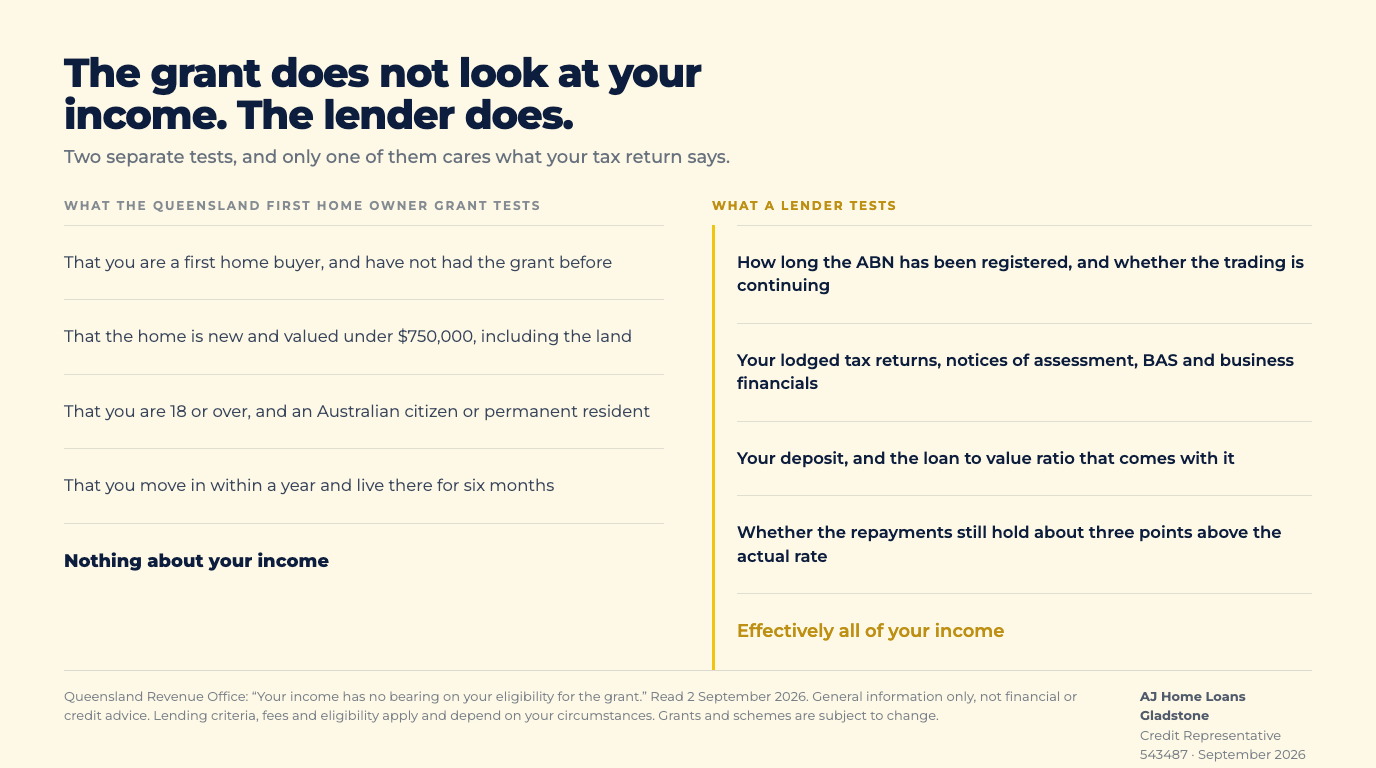
There is a widely held belief that the Queensland First Home Owner Grant is out of reach until you have two years of tax returns behind you. It is worth clearing up first, because it stops people applying who never needed to wait.
The Queensland Revenue Office says it plainly on its own eligibility page: “Your income has no bearing on your eligibility for the grant.” [1] The grant tests other things instead. You have to be a first home buyer, the home has to be new and valued under $750,000 including land, you have to be 18 or over and an Australian citizen or permanent resident, and you have to move in within a year of completion and live there for six months. Nothing on that list looks at what you earn, how you earn it, or how long your ABN has been registered. The amount is $30,000 for contracts signed on or after 20 November 2023. [1]
The low deposit route works the same way. The Australian Government’s 5% Deposit Scheme has carried no income caps since 1 October 2025, and the Queensland property price cap outside Brisbane, the Gold Coast and the Sunshine Coast is $700,000, which covers Gladstone. [2]
So where does self-employment actually bite? On the loan. It does not change whether you qualify for a grant or a deposit scheme. It changes how a lender works out what you can borrow, and how much deposit you need before one of them will write it. Nearly every “I could not get the grant” story turns out to be an “I could not get that loan yet” story, and the difference matters, because the two have completely different fixes.
What a lender actually asks a self-employed borrower for
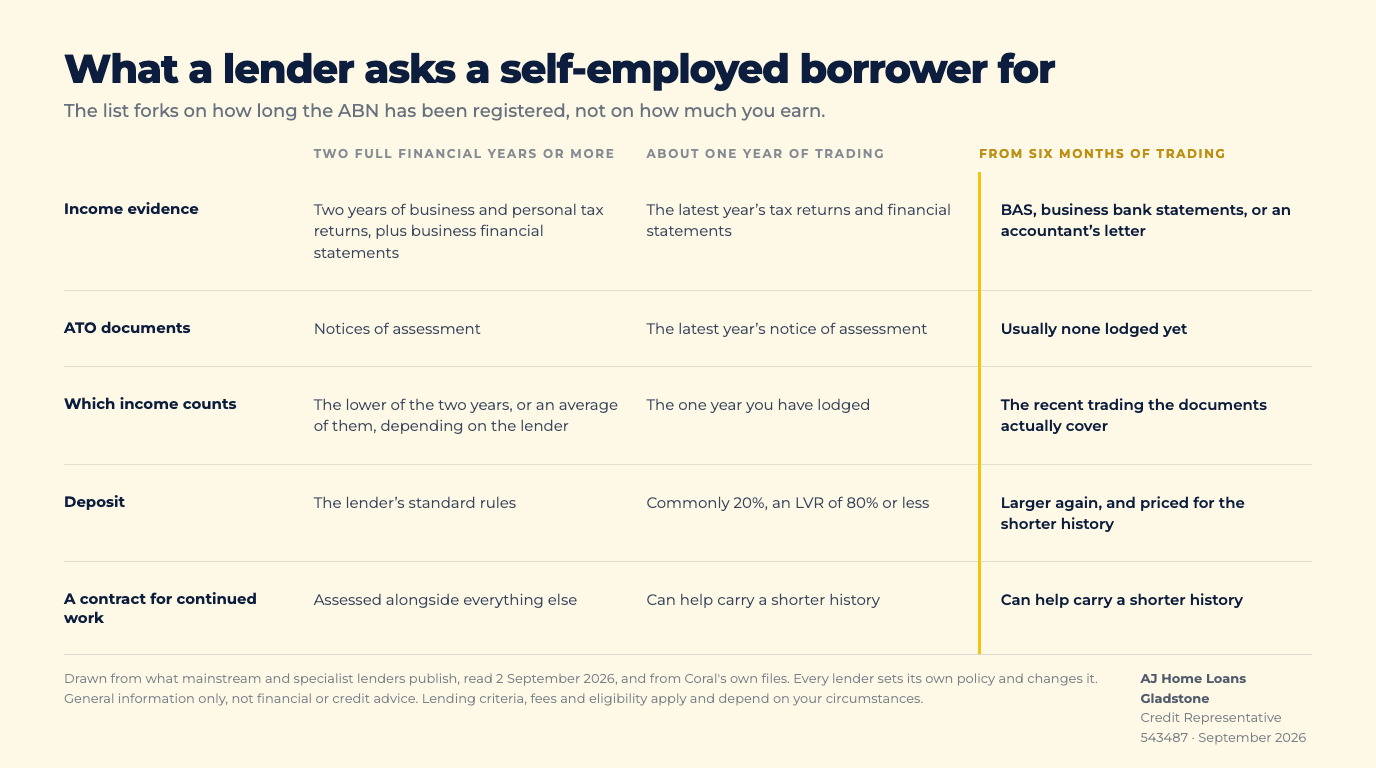
The document list is not one list. It forks on how long the ABN has been registered, and a contract for continued work is assessed on top of whatever else you supply.
If it is a long-term business owner, ABN registered for two years, then two tax returns, and the lender uses the lower of the two for the income assessment. If it is a new business under two years of trading, their BAS statements and a letter from their accountant. If they have a contract for continued work, the bank assesses that as well. It depends on what you do for a living.
Two full financial years, the standard path
This is what the mainstream lenders publish. St.George’s headline requirement is to “Be self-employed for more than 2 full financial years” with a registered ABN as a sole trader, business partnership, company or trust, and its standard assessment asks for the latest two years of business and personal tax returns, the latest year’s personal ATO Notice of Assessment, and two years of business financial statements. [3] NAB’s list runs the same way: personal and business tax returns for the past two years, notices of assessment from the ATO, profit and loss statements, balance sheets, personal and business bank statements, and ABN and GST registration details. [4]
The part that catches people is which year gets used. My experience is that the lender takes the lower of the two, and lenders differ on this: BOQ describes the assessment as one where “the lender may look at two years of tax returns and take an average of those years”. [5] Either way, a strong recent year does not simply replace a weaker earlier one, so a business that has grown quickly is usually assessed on less than it is earning today. That is worth knowing before you work out your own borrowing capacity.
Under two years of trading
Below two years the paperwork changes shape rather than disappearing. BAS statements and an accountant’s letter is exactly what the lenders who write this business ask for. Pepper Money accepts applications with “just six months of ABN activity”, and its alt doc path asks for evidence of GST and ABN registration for at least six months, a declaration of financial position, and then one of three things: six months of business bank statements, six months of lodged Business Activity Statements, or a Pepper Money accountant’s letter. [6] NAB accepts BAS “if tax returns aren’t available”. [4]
One year of returns, and where the deposit comes in
One full financial year is a real path with some lenders, but read bank pages carefully here, because two different requirements get conflated and they are not the same thing.
The first is how much trading history a lender wants. NAB puts its range at “at least 1 to 2 years of self-employed income history” and states that it “allows a single year’s financial statements to explore lending opportunities where loan-to-value ratio (LVR) is 80% or less”, which is another way of saying with a 20% deposit. [4] Pepper Money goes shorter again at six months of ABN activity. [6]
The second is how much paperwork a lender wants once you already clear its trading-history bar. St.George is the clearest example of the difference. Its eligibility line is “Be self-employed for more than 2 full financial years”, and that applies across all three of its assessment paths. What its Fast Track and 1-Year Assessment options change is the documents, not the history, and Fast Track carries its own condition: “You’ll need 20% of the property’s value as your deposit.” [3] So a bank advertising a one-year assessment is not necessarily offering it to someone who has been trading for one year.
The deposit sits underneath both. The shorter your history, or the lighter the paperwork you want to supply, the more work the deposit has to do. Lenders are not refusing to look at you. The ones willing to work with less mostly want you bringing more of the purchase price yourself. That is the same question a good pre-approval conversation should be answering before you go looking at houses.
Two years versus one, and what the shortfall costs you
Two years is better. You get treated the way a PAYG borrower would be. With less than that it usually becomes a specialist product, and you pay for it in the rate and the fees, unless you have a contract for continued work. Having a chat and telling me what you are doing and where you are at, that is where to start. I can work it out and tell you how to get there.
Worth being clear about what a specialist product means in practice. It is a loan you can get, priced for the extra uncertainty the lender is carrying. Whether taking it now beats waiting for the second return depends entirely on your own numbers and your own timing, which is a conversation rather than an article.
The subcontractor who did not have to wait
He had been under his own ABN for less than two years, but he had worked in the same trade for years before that. He had one full financial year done, his tax return and financials were up to date, his recent BAS statements and business bank statements showed the income was continuing and increasing, and he had a contract for continued work. He did not need to wait until he had two years of tax returns. I found a lender whose policy let them consider his latest year alongside his industry experience and how the business was actually performing, and it was approved. The difference was that his income could be clearly verified, the business was performing consistently, and he had stayed in the same line of work.
Three things carried that file, and they are the transferable part: the income could be verified from documents, the business was performing consistently, and he had stayed in the same line of work. Note what is not on that list. He did not have two years of returns. Every lender applies its own policy here, so that describes one file rather than a rule, which is the same reason it pays to understand what lenders look for before you pick where to apply.
The first home buyer at three months
The other end of the same problem, and the reason the grant confusion is worth correcting.
He was three months in, with years of experience in the same industry behind him. The grant was never the problem, the grant does not look at your income. The problem was that at three months of trading, a lender was not going to do a low-deposit loan. So it came down to a bigger deposit now at a higher rate, or waiting until the returns were there.
Read that situation as “no grant for two years” and the only available answer is to give up for two years. Read it correctly, as a low deposit lending problem, and there are moves on the board: build the deposit towards 20% and buy sooner on a shorter trading history, or keep trading and lodge the second return, or look at whether a contract for continued work changes the picture. The grant sits there either way, as long as the home is new and under the value cap. That is also why it is worth reading the first home buyer loans page alongside this one.
What this looks like in Gladstone specifically
Gladstone’s self-employed population leans heavily towards trade and contracting work, and a few patterns come up here more than they would elsewhere:
- Years of industry experience before the ABN was ever registered. It does not replace a tax return, but it is often the thing that makes a shorter trading history credible to a lender.
- Income that arrives in blocks around shutdowns and project work rather than evenly across the year. Recent BAS and business bank statements are what show a lender the pattern is real and continuing.
- People running their own ABN while also being paid as an employee somewhere else. That is two income types on one file, and lenders treat the mix differently from one another.
- A tax return written to minimise tax, which is sensible in April and unhelpful in the month you apply. What your accountant can deduct is not always what a lender will add back.
Serviceability sits on top of all of it. Lenders assess your repayments at roughly three percentage points above the actual rate under APRA’s serviceability buffer, so variable income is being tested against a rate you are not actually paying. [7] If part of your income comes from overtime and shift allowances as well as your ABN, that is assessed under a separate set of policies again.
Working under your own ABN and thinking about buying? Let’s see what a lender would actually count.
Bring your last return, your recent BAS and your business bank statements, and we will work through which lenders would read your income the way you actually earn it, and what deposit each of them would want.
- Access to ~70 lenders
- Phone, video or in person
- 7am to 7pm, 7 days
- Usually no client fee (lender-paid, though complex files may attract a fee)
Frequently asked questions
Do I need two years of tax returns to get the Queensland First Home Owner Grant?
No. The Queensland Revenue Office states that “Your income has no bearing on your eligibility for the grant.” [1] The grant looks at first home buyer status, a new home valued under $750,000, your age and residency, and the requirement to move in within a year and live there six months. Two years of returns is a lender requirement for the loan, not a grant requirement.
Can I get a home loan with only one year of self-employment?
Sometimes, and usually with a larger deposit, but it turns on the lender’s trading-history rule rather than its document list. NAB names a range of “at least 1 to 2 years of self-employed income history” and allows a single year’s financial statements where the loan-to-value ratio is 80% or less, meaning a 20% deposit. [4] Pepper Money accepts six months of ABN activity. [6] Read bank pages closely though: St.George offers a 1-Year Assessment, but its eligibility still requires being self-employed for more than two full financial years, so that option changes the paperwork rather than the history. [3]
What if I have been trading for less than a year?
There are lenders who work at that end of the market. Pepper Money accepts six months of ABN activity and verifies income from business bank statements, lodged BAS or an accountant’s letter rather than tax returns. [6] Expect the pricing to reflect the shorter history.
Which year of income will a lender use if I have two lodged?
Do not assume the most recent and higher one. My experience is that the lower of the two years is used for the assessment, and some lenders average the two instead. [5] Either way, a business that has grown quickly is usually assessed on less than it currently earns.
Does being self-employed affect the 5% Deposit Scheme?
The scheme itself carries no income caps, and the Queensland price cap outside the south east is $700,000, which covers Gladstone. [2] What self-employment affects is whether a participating lender will approve the loan sitting behind it, which comes back to trading history, documents and deposit.
Is a contract for continued work worth anything?
It can be. Where one exists, the lender assesses it alongside the rest of the file, and it was part of what carried the approved application described above. It is not a substitute for verifiable income, and no lender is obliged to weigh it the same way as another.
Sources and further reading
- Queensland Revenue Office, first home owner grant eligibility, read 2 September 2026: https://qro.qld.gov.au/property-concessions-grants/first-home-grant/eligibility/
- Australian Government 5% Deposit Scheme, read 2 September 2026: https://firsthomebuyers.gov.au/
- St.George Bank, self-employed home loans, eligibility and the Fast Track, 1-Year and 2-Year assessment document lists, read 2 September 2026: https://www.stgeorge.com.au/personal/home-loans/self-employed
- NAB, how to get a home loan if you’re self-employed, read 2 September 2026: https://www.nab.com.au/personal/home-loans/self-employed-home-loan
- BOQ, how to apply for a home loan when you’re self-employed, read 2 September 2026: https://www.boq.com.au/blog/property/buying-a-home-when-self-employed
- Pepper Money, home loans for self-employed borrowers, alt doc requirements, read 2 September 2026: https://www.peppermoney.com.au/home-loans/self-employed
- APRA, macroprudential policy settings including the serviceability buffer: https://www.apra.gov.au/news-and-publications/apra-keeps-macroprudential-policy-settings-steady
Lender policies named above are cited as published examples of how mainstream and specialist lenders assess self-employed income. They are not a recommendation of any lender, and each one sets and changes its own policy.
This page is general information only and does not constitute financial or credit advice. Lending criteria, fees and eligibility requirements apply and will depend on your individual circumstances. Government grants and schemes are subject to change.